
Terracotta Krater
Made to order
Contact Archaeopolis to arrange the quantity, dimensions, finish and production schedule for your commission.
A broad-mouthed terracotta-coloured krater with a flaring rim, two upward-curving handles and a raised circular foot. Its open body gives the vessel a strong architectural presence.
Historical context
The krater belongs to the ancient Greek family of mixing bowls. Museum typologies distinguish several forms, including bell, column, volute and calyx kraters. Here the historical name identifies the broad vessel family; the photographs document the modern Archaeopolis piece.
The Met — Greek Vase Painting, vessel shapes
Photographic documentation
Archaeopolis Objects archive, ceramic series, photographs 009. The images show finished contemporary pieces by collaborating workshops and artists. Handmaking can produce individual variations in surface and finish.
View the Ceramic Vessels & Tableware archive
Archaeological comparison
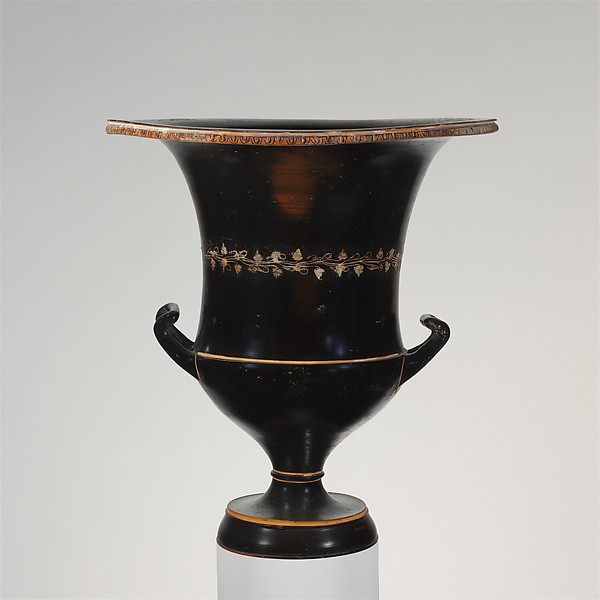
The ancient calyx-krater below offers a comparison for the flared mouth, low-set curved handles and foot. Its taller proportions and black-glazed decoration differ from the contemporary piece offered here.
MADE BY HUMAN HANDS
Every Archaeopolis object is handcrafted.
Made by people, with time, care and individual attention.