
Hoplite Shoes — Articulated Foot Armour


Hoplite Shoes — Articulated Foot Armour
€2,500 per pair · Made to order
A pair of articulated foot guards with sculpted toe caps, hinged instep plates and ankle straps. Designed and art-directed by Georgios Katsos / Archaeopolis and handcrafted by Dimitris Katsikis, this contemporary interpretation brings an unusual form of ancient armour into the Archaeopolis collection.
Your commission
The two main product photographs show the Archaeopolis pair. Visible details include anatomical toe modelling, hinges across the forefoot, an instep shell, stitched straps and an inner lining.
Please contact us before ordering to agree measurements, fit, exact materials, finish and production time. Each pair is supplied by commission; no next-day dispatch is promised for this item. Shipping is free within Greece and €19 internationally under the current store rates.
Discuss fit and production time →
Archaeological context: the Ruvo foot-guards
A particularly close comparison is a pair of ancient bronze foot-guards from Ruvo in southern Italy, now in the British Museum. Dated to around 520–480 BCE and described as Greek or Italian, they cover the upper foot and reproduce the toes in metal. Hinges connect the toe plates to the instep sections.
Their anatomical modelling and articulation offer a useful comparison with the Archaeopolis form. This comparison concerns visible construction; it does not establish an exact reproduction of this specific ancient pair.

Archaeological reference: Ruvo foot-guards, c. 520–480 BCE. British Museum, 1856,1226.714. Photograph: Gre regiment / Wikimedia Commons, CC BY-SA 4.0. Unmodified photograph. Museum objects are not included in the sale.

British Museum collection record →
Related evidence: ankle protection
The Metropolitan Museum of Art holds a Greek pair of bronze ankle guards, 5th century BCE, protecting the area below the greave. Ankle guards are a related but different type from the hinged toe-and-instep armour above. Their museum-recorded lengths are 23.2 cm and 22.7 cm; these are measurements of the ancient objects, not the size of the Archaeopolis commission.
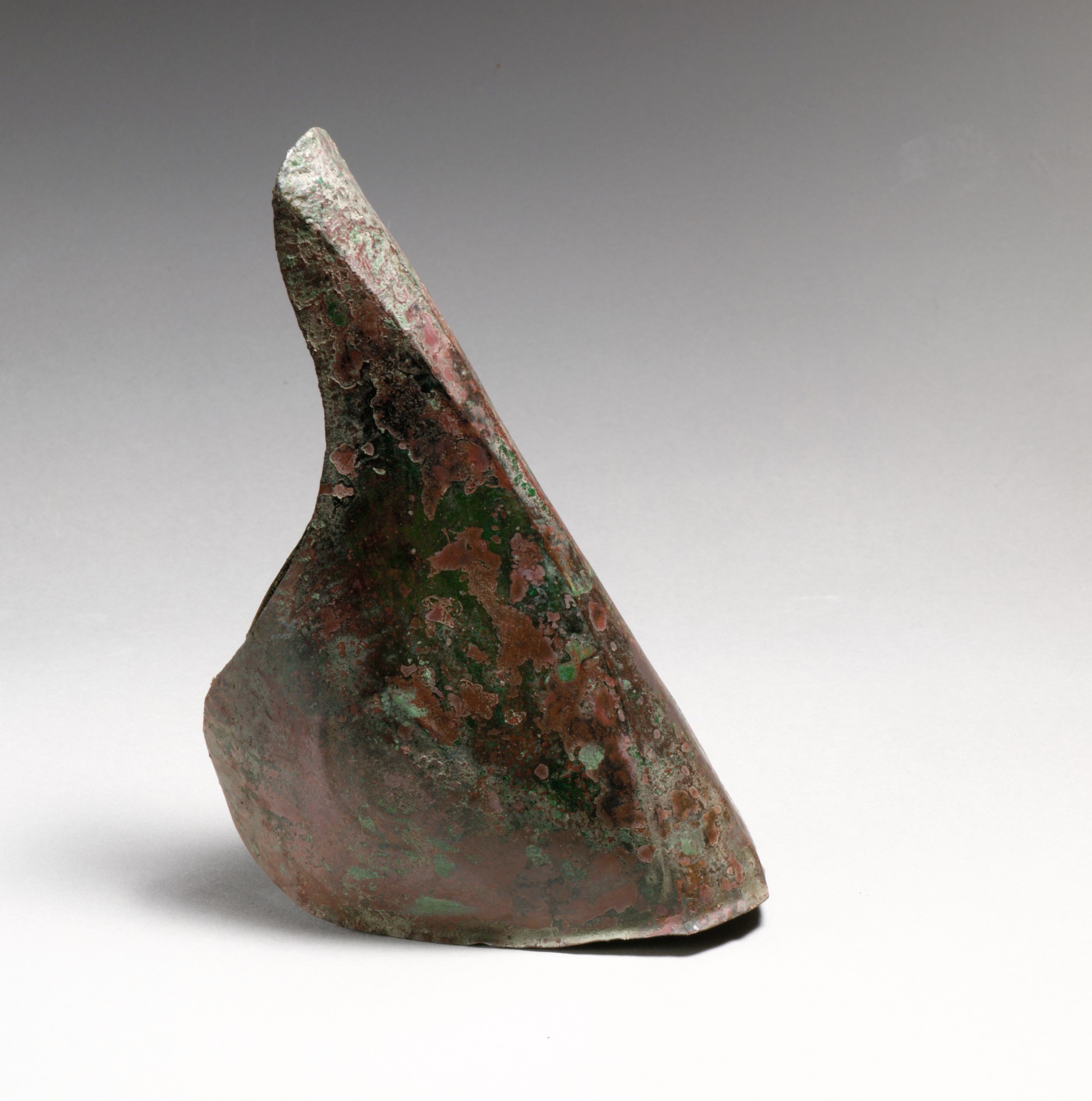
Archaeological comparison: one ankle guard from a pair, Greek, 5th century BCE. The Metropolitan Museum of Art, 1982.11.5, .6. Met Open Access / CC0.
Reading the evidence
Foot-guards are rare finds. Michael Burns discusses the Ruvo pair’s hinges, modelled toes and possible lining attachments in his study of south Italic armour. Perforations may relate to an inner lining, while original padding, fit and attachment remain matters of interpretation. See Burns, 2006, section 4.11.
“Hoplite Shoes” is the Archaeopolis collection name, not a claim that every Greek hoplite wore this form. The straps, lining and finish visible in our product photographs belong to the modern workshop interpretation. Exact alloy and material specifications are agreed for the commission rather than inferred from the colour of a photograph.
Further reading: Dietrich von Bothmer, Armorial Adjuncts, Metropolitan Museum Journal 24 (1989), pp. 65–70.