
Openwork Axe — Carved Grip

Openwork Axe — Carved Grip
€750 per piece · Made to order
An openwork head with two large openings above a shaped, carved grip and contrasting hanging ties. This Archaeopolis design combines a light-filled silhouette with a distinctly articulated haft.
Design concept and aesthetic direction: Georgios Katsos and Archaeopolis. Handcrafted by Dimitris Katsikis. The price is for one openwork axe — carved grip, as shown in the product photograph.
Your commission
Material specification, overall dimensions, weight, surface finish and production schedule are agreed with the workshop before production. Please discuss your requirements before ordering if the object must meet a particular display or production brief. This piece is made to order; dispatch is scheduled for your commission.
Shipping: complimentary within Greece; €19 internationally under the shop's current shipping rates. Dispatch timing is confirmed for your commission. Photographs record existing workshop pieces; natural surface and hand-finishing differences are part of the individual making process.
Archaeological comparison
The museum object below is a comparison of visible form. It is separate from the contemporary Archaeopolis piece offered here.
Openwork axes of the Levant
The Met's 61.29 is a Canaanite bronze fenestrated axe blade from the Levant, dated to the early second millennium BCE. “Fenestrated” describes the openings in the head. The comparison concerns two openings separated by a central rib within a curved blade. The ancient head has a socketed mounting; this Archaeopolis design uses a visibly different arrangement of attachments along the haft. The comparison supports the openwork principle, not an identical reconstruction. Museum record.
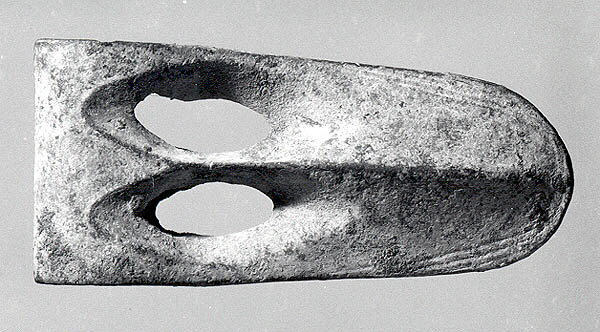
Archaeological comparison: Canaanite fenestrated axe blade, 61.29. The Metropolitan Museum of Art, Rogers Fund, 1961. Open Access / public domain (CC0).
Daria Montanari's study of four broad fenestrated axes in the British Museum distinguishes broad, eye-like forms from elongated “duckbill” forms and examines their changing roles in the Levant around the late third and early second millennia BCE. Finds in funerary, votive and other contexts show why a head's appearance should not automatically be equated with battlefield use. Symbolic interpretations depend on the individual object and its context. Montanari, 2021.
The Odyssey: twelve axes, one enduring question
In Homer's Odyssey, Book 21, Penelope sets the challenge of stringing Odysseus' bow and sending an arrow through twelve axes. Telemachus arranges the axes, and Odysseus ultimately completes the shot. The passage connects these objects with recognition, skill and the recovery of the household. See especially 21.75–79, 120–123 and 419–423 in the Perseus text.
The physical arrangement has generated scholarly debate. Denys L. Page's A Problem in Homer's Odyssey, for example, explores an interpretation involving openings at the ends of axe handles. A modern openwork head may suggest a visual way to imagine the episode, but it does not settle the meaning of the poem or identify Odysseus' axes archaeologically. Read Page's discussion.
From Homer to Christopher Nolan
Christopher Nolan's The Odyssey is a cinematic adaptation of Homer's epic, as described by Universal Pictures. It offers a contemporary point of entry into the poem and its material world. The reference here is cultural context: these Archaeopolis objects are independently designed commissions and are not presented as props used in the film, licensed film replicas or merchandise endorsed by its production.
Sources
- The Metropolitan Museum of Art, fenestrated axe blade, 61.29, Canaanite, early second millennium BCE.
- Daria Montanari, Four Broad Fenestrated Axes in the British Museum, Vicino Oriente 25 (2021), 61–80.
- Homer, Odyssey, Book 21, especially 21.75–79, 120–123 and 419–423; A. T. Murray translation.
- Denys L. Page, A Problem in Homer's Odyssey, University of Athens digital repository.
- Universal Pictures: Christopher Nolan's The Odyssey, cited solely for the film reference.
- Museum photograph: Met Open Access, public domain / CC0.
MADE BY HUMAN HANDS
Every Archaeopolis object is handcrafted.
Made by people, with time, care and individual attention.